

Welcome to the 78th issue of Unit Economics. In this post, I look back at the Credit Card on UPI thesis and share my thoughts on why – four years later – it has not exactly played out for anyone but RuPay. Dive in!
Credit card on UPI was launched with a simple thesis.
By 2022, credit cards in force had been growing in double digits each year, while card spends were doubling every 4-5 years. These were good numbers. But India, with only 4-6% credit card penetration in its adult population, was operating from a very low baseline. In comparison, the USA, with a population 1/4th of its size, had 80%+ penetration.
This meant that (a) India had lots of room for growth and (b) at the current rate of growth, it would take multiple decades to bring credit card access to the majority.
UPI, at the time, was only six years old. Yet, versus credit cards, it was already
processing 2 times the merchant spend (~₹2.4 Lakh Cr / mo),
accepted by 8-10 times more merchants (5 Cr), and
used monthly by 15 times more users (30 Cr)
UPI had grown digital payment access 4-5X times in the country, and enabled payments online for millions of users and merchants for the first time. With credit cards, it hoped to do the same for credit access.
To the card issuers, access to UPI was an opportunity to solve the credit card growth problem. In theory, it should allow them to:
Underwrite new users, using the payments data; especially those who had thin credit files or were new-to-credit or credit card,
Acquire more cheaply, with (a) easier cross-sell through daily-use UPI apps, and (b) the cost savings on physical cards, and
Capture a larger share of wallet of the carded users, by moving their spends on smaller merchants – who traditionally lacked ways to accept cards – from bank accounts to credit cards.
These were sufficient reasons for the regulator to also feel excited. But it helped that, in addition, credit cards on UPI would:
Allow RuPay, the home-grown card network, to make UPI its walled garden for breaking the Visa-Mastercard duopoly, and
Become the proof-of-concept for how merchants and the ecosystem would react to a higher MDR on UPI payments.
Almost four years after the release of its operating circular in Oct-22, how have the RuPay Credit Cards on UPI fared?
RuPay is winning
In 2022, RuPay had a 2-3% share of all outstanding credit cards and card spends. Today, its share of outstanding credit cards is more than 10%, while that of spending is ~18-20%.
This is a huge jump for a 4-year period. And points to a future where RuPay may take the majority of card spends within the next 8-10 years, if the following continue:
A) RuPay’s share of new credit card issuances today is ~35-40%, allowing it to quickly capture market share. While the issuers - with UPI - had a natural incentive to issue more RuPay cards, it has been boosted further by (a) the ‘24 RBI circular that mandated that the issuers provide choice of network to customers in any new or existing card arrangement and (b) the NPCI’s almost-predatory incentivisation to the issuers.
As a result, SBI Cards and HDFC Bank, who combined drive 40% of the market, have introduced 10+ RuPay variants each over the past 4 years. ICICI and Axis Bank are also catching up.
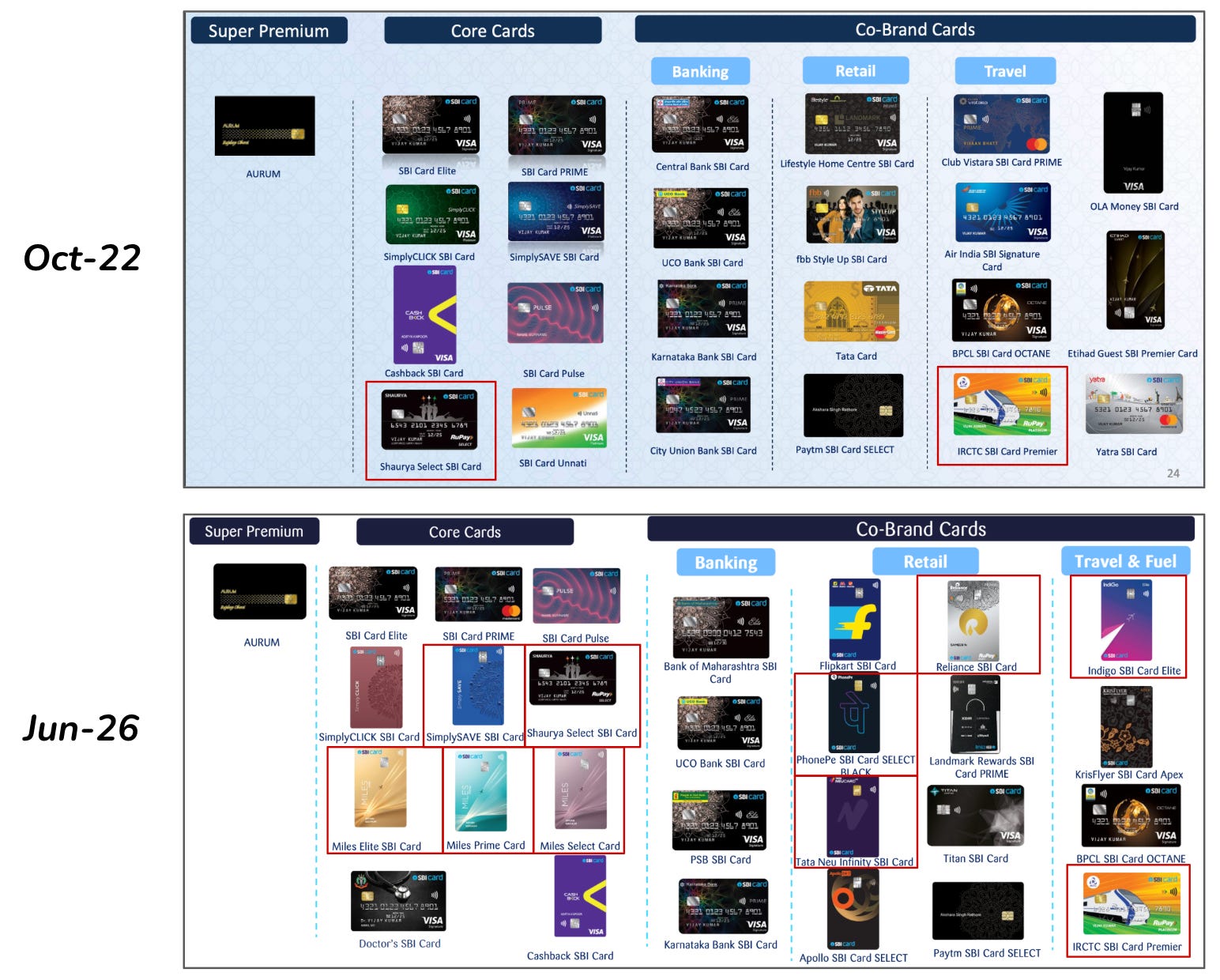
B) RuPay credit cards have a 15-30% higher spend per card versus the market average today. This is due to the following:
RuPay cards are more frequently used as top-of-wallet, given (a) that most cardholders would have <2 RuPay cards on average, making them less competitive for UPI spends (including e-commerce, which is 80% UPI-driven), and (b) they are more likely to be made the default due to their ~3X transaction frequency versus the non-UPI cards.
RuPay portfolios have a higher 30-day spend active rate, i.e., less dormancy, due to higher transaction frequency with UPI & lower vintage for the newly issued portfolio of cards. For eg: SBI Cards has a 30-day spend active rate of ~50-55% across their portfolio, but the same is > 60% for most co-brand RuPay programs.
As a result, RuPay has gained 12-15 times more spend, and NPCI has gained the same in top-line over the four years. But..
Card issuers are yet to see gains
Between Aug-18 and Aug-22, the outstanding credit cards in India had grown by 3.7 Cr (37 Mn), from 4.1 Cr to 7.8 Cr. In the four years since the RuPay on UPI release, between Aug-22 and Aug-26, the cards have grown by 4.5 Cr (45 Mn), from 7.8 Cr to 12.3 Cr.
The increase in new originations is hardly ~5% year on year for the two periods, and that too can be normalised given the COVID-19-forced slowdown during the 2018-22 period.
This suggests that while RuPay may be taking up 35-40% of all new originations, the growth it’s driving is largely cannibalising – and not additive – in nature. For the issuing banks, this may have shifted their portfolio shape, but has hardly contributed to meaningful cards business.
Monthly spends, similarly, grew from ₹48,000 Cr in Aug-18 to ₹1.12 Lakh Cr in Aug-22, i.e., 2.3X, with a net addition of ₹64,000 Cr. The figure for Jul-26 was ₹2.08 Lakh Cr, suggesting a 1.85-1.9X growth over the four years with net addition of ₹96,000 Cr, i.e., 50% higher than the previous period.
The 50% figure may sound promising, but most of this jump was expected given (a) the higher base of the recent period and (b) the growth in e-commerce spends, where such online spends now form >60% of card spends versus just 40-45% by FY19.
This again suggests that while RuPay cards may be powering ₹22,000 to ₹27,000 Cr of monthly spends on UPI today, they are contributing little to overall card spend growth. This is despite the ~3.7X growth in UPI merchant payments for the last four years, from ₹2.39 Lakh Cr. per month to ₹8.95 Lakh Cr., which suggests that UPI hasn’t really slowed down.
Credit cards on UPI were supposed to catapult card originations and spends into a new direction, but apart from replacing the network distribution in the portfolios, the shift has been largely unnoticeable. What explains the indifference?
Underwriting remains bureau-dependent; Risk teams are wary of experiments
More than 70% of the entire credit card market is owned by four issuers: HDFC Bank, SBI Cards, ICICI Bank, and Axis Bank. The other 30% is constituted by 50+ other banks. This implies that if the market needs to change, these four issuers need to champion the cause.
While the UPI payments data was expected to supercharge approvals for these issuers, the same hasn’t happened for two reasons:
The increased scrutiny on consumer credit exposure and vigilance towards risk policies & onboarding processes from the RBI has made the issuers more conservative in their approach towards underwriting. For eg: as a fintech, it has become more challenging to co-create risk policies for new-to-credit or thin-file customers on cards, given the lower appetite from the issuers. While this directly impacts the top issuers, even the challenger banks (small-finance banks, or smaller scheduled commercial banks), where credit cards are a smaller share of top-line, have become conservative due to the fear of the RBI.
As an outcome, large-scale fintech companies, incl. CRED and PhonePe, are also designing UPI cards not as general-purpose use cards, but as on-platform engagement propositions (giving rewards on utility & commerce spends). While lack of risk-policy involvement contributes to this, it is exaggerated further due to (a) limited access to off-platform card transactions and (b) poor interchange rates on the UPI Card transactions. This brings me to the next argument.
Lower net interchange impacts everything
When creating a rewards proposition for a card program, the issuer & the co-brand first subsidise the rewards costs from the interchange in the P&L. But RuPay credit cards, with 60%+ of their spends over UPI, see a net interchange that is 30-40 bps lower than that for the non-UPI cards (due to exemption of interchange on smaller merchants).
With a lower interchange, the issuer is left with only two options: (a) keep a poorer rewards proposition or (b) add breakages through annual fees, redemption limits, etc. Most lean towards the latter. But regardless, with either of these paths, the virality and acquisition of the card take a hit.
As a result, while issuers are increasingly introducing RuPay cards, they continue to have to push Visa-Mastercard cards for offline use.
Acquisition costs remain high; Cards compete with UPI cashbacks
The thesis with Credit Card on UPI’s existing distribution was that it would help make acquisition cheaper for the issuers. But that’s not really playing out.
The co-brand market has become more competitive, with tens of fintech companies going after the same users. This has led to the costs of all channels: performance marketing, affiliates, and media buy to become elevated, with average cost of acquisition upwards of ₹2,500.
The UPI TPAPs are equally filling the market with cashbacks for UPI acquisition, making the card value propositions – already depleted with low interchange – tough to stand out. With it, the hope that the likes of PhonePe and GPay would somehow help acquire millions of cards is also growing thin.
The first four years of Credit Card on UPI seem to have made only one winner till now, while the issuers, fintech companies, and the users continue to struggle with poor approvals, low interchange rates, and limited growth.
If the direction were to change for the next four years, and without sounding like a broken clock, I hope that we see
extension of power to the co-brands – to enable more approvals and better cross-sell,
introduction of interchange across smaller merchants and all ticket sizes – to enable better value propositions, which leads to a wider top of the funnel + lower acquisition costs,
incentives to the challenger banks (small finance banks, smaller SCBs, and NBFCs) to spread credit card portfolios wider, and
an equal opportunity to Visa and Mastercard on UPI, as a little competition can only be good for the growth of the market.
If you want to discuss the topic, please reply to the article or feel free to reach out to me over email or LinkedIn. Until next time!